
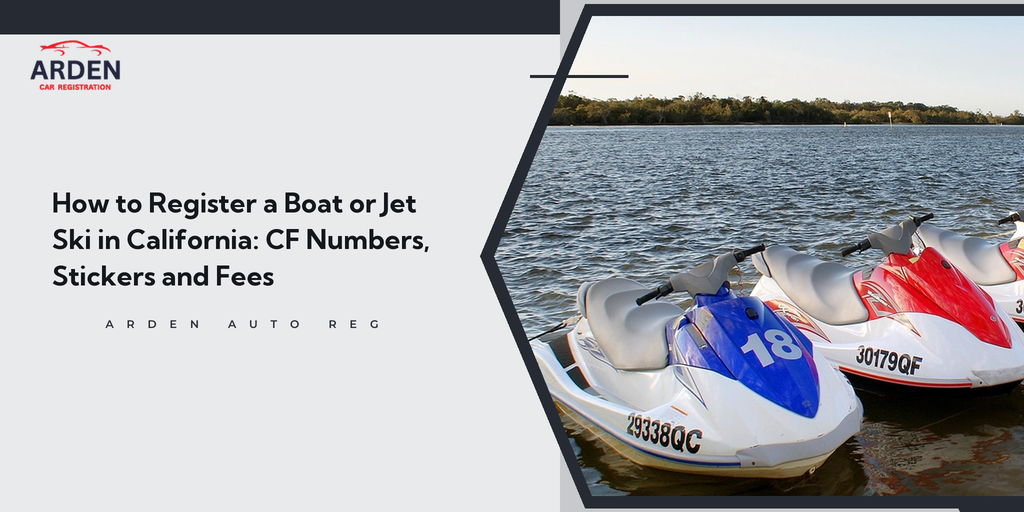
You just bought a used ski boat off a guy in Elk Grove, or maybe a pair of jet skis for summer weekends at Folsom Lake. Before you back that trailer down the launch ramp, there’s paperwork. If you need to register a boat in California, the process runs through the DMV, and it has its own rules, numbers and stickers that don’t work quite like a car.
This guide covers which vessels need registration, how CF numbers and stickers have to be displayed, how the two-year renewal cycle works, and what changes when you buy used or bring a boat in from another state. Arden Auto Reg handles vessel registration in Sacramento, so we see the common mix-ups every season.
Which Boats and Jet Skis Have to Be Registered?
In California, vessel registration is handled by the DMV, not the parks department. Under California registration rules, these vessels must be registered if they aren’t documented with the U.S. Coast Guard, and you can see our complete list of supported vehicles and vessels on our services page:
- Motorboats of any size
- Sailboats over 8 feet long, or any sailboat with a motor
- Personal watercraft, like jet skis and wave runners
- Inflatable boats with motors
- Houseboats
- Motorized jet boards and eFoils
And these generally don’t need California registration:
- Kayaks, canoes and other boats powered only by oars or paddles
- Sailboats 8 feet or shorter with no motor
- Boats documented with the U.S. Coast Guard (they follow a federal process instead)
- Boats with valid numbers from another state that haven’t changed their main state of use and haven’t been in California for more than 90 days in a row
Here’s the rule of thumb: if it has a motor, even a small electric trolling motor on an inflatable, plan on registering it.
| Vessel | Register with DMV? |
|---|---|
| Jet ski or other personal watercraft | Yes |
| Ski boat, fishing boat, pontoon | Yes |
| Inflatable with an outboard or trolling motor | Yes |
| Sailboat over 8 feet | Yes |
| Kayak or canoe (paddle only) | No |
| Sailboat 8 feet or less, no motor | No |
What a CF Number Is and How to Display It
When you register, the DMV assigns a permanent vessel number called a CF number. It always follows the same pattern: the letters CF, four numbers, then two letters, like CF 1234 AB. The number stays with the boat, not with you, so when you buy a used boat, its CF number comes along.
California is specific about how the number goes on the hull:
- Put it on both sides of the forward half of the boat, usually on the bow
- Use plain, vertical block characters at least 3 inches tall
- Pick a color that contrasts with the hull so it’s easy to read
- It must read left to right
- Separate the letters and numbers with a space or hyphen, like CF 1234 AB or CF-1234-AB
Keep other numbers, letters and decorations away from it so the CF number stays easy to read from another boat.
Registration Stickers and the Quagga and Zebra Mussel Fee Sticker
Your Registration Sticker
Along with the CF number, you’ll get registration stickers. One goes on each side of the boat, 3 inches behind and in line with the CF number. When you renew, scrape off the old ones and put the new stickers in the same spot.
The Mussel Fee Sticker
California charges a Quagga and Zebra Mussel Infestation Prevention Fee on vessels used in fresh water. These invasive mussels can clog water systems and damage engines, so the state funds prevention work with this fee.
If your boat is used on lakes, rivers or reservoirs, or anywhere in the Sacramento-San Joaquin Delta, you need the Mussel Fee sticker. That includes Folsom Lake, Lake Natoma and the American River. The only exemption is for boats used only in marine waters, meaning the ocean and coastal bays. DMV specifically says the Delta does not count as marine water.
One important change: the DMV now sells the Mussel Fee sticker separately through its online Quagga Sticker Request, and it’s mailed to you on its own. Business partners, Arden included, are no longer able to issue it. We can still complete your registration and point you to the right DMV page for the mussel sticker. Display it next to your registration sticker.
Carbon Monoxide Warning Stickers
Motorized vessels issued a CF number also get carbon monoxide warning stickers. One goes on the outside of the transom, the other near the helm where the driver can see it.
How to Register a Boat in California, Step by Step
Step 1: Figure Out Which Situation You’re In
A new boat from a dealer, a used boat from a private seller, and a boat from another state each follow a slightly different path. Dealers usually handle new-boat paperwork.
Step 2: Gather Your Documents
For a brand-new boat or one coming from out of state, the main form is the BOAT 101, the DMV application for an undocumented vessel. It asks for the hull identification number (HIN), builder, model year, purchase price and purchase date. Every registered boat needs a HIN. If a homemade boat doesn’t have one, DMV can assign it.
For a used California boat, you’ll mostly be working with the existing California Certificate of Ownership, which we cover below. Either way, expect registration or transfer fees, plus use tax on most purchases.
Step 3: Mark the Boat and Keep the Paperwork Aboard
Apply your CF number and stickers as described above. Keep the certificate of number (the boat’s registration card) on board whenever you’re on the water. If you received a temporary certificate while the permanent one is mailed, keep that aboard instead.
Step 4: Get Your California Boater Card
This one isn’t part of registration, but it catches people off guard. Since January 1, 2025, anyone operating a motorized vessel in California, at any age, needs a California Boater Card. It’s issued by state authorities after you pass an approved boating safety exam. If you need help getting your vessel registered or transferring a boat title, feel free to reach out to our Sacramento team. Registering the boat doesn’t give you the card, and the card doesn’t register the boat. You need both.
Buying a Used Boat or Jet Ski From a Private Seller
Most of the boats we see are used. Here’s what a clean private-party transfer needs.
The California Certificate of Ownership, signed correctly. The seller signs to release interest. If there’s a lienholder listed, they need to sign too, or provide a lien release. If the boat is owned by two people joined by “and,” both have to sign.
The buyer’s section filled in. You add your full name, address where the boat will be kept, and the purchase price and date. Leaving the price blank causes delays.
A bill of sale. It’s good protection for both sides, and the DMV accepts it in place of the seller’s signature on the release line in some cases.
A lost title plan. If the seller lost the title, they’ll need to fill out the REG 227 Application for Replacement or Transfer of Title. Our guide to replacing a lost title explains how that form works.
Don’t sit on the paperwork. The DMV adds a penalty when transfers are filed late, and until the transfer posts, the boat is still on the seller’s record. We’ve written about why title transfer delays can cause legal headaches, and the same logic applies on the water.
Buying the trailer too? The boat and trailer are registered separately. Ask the seller to list separate prices for each on the bill of sale, and see our California trailer registration guide for the trailer side.
Bringing a Boat From Another State
If California is now where you mainly use it, it needs California registration. The DMV’s current manual gives you 120 days from the date the boat entered the state, after which penalties apply.
You’ll need a BOAT 101, plus your out-of-state title. If your old state doesn’t title boats, bring the out-of-state registration and proof of ownership like a bill of sale. Use tax may be due if the boat came into California within 12 months of the purchase date, with credit for sales tax you already paid to another state.
Already handling your car too? Our post on out-of-state vehicle registration for new residents covers that side of the move.
Renewals and Costs
The Two-Year Renewal Cycle
California vessel registration runs on a two-year cycle that ends on December 31 of every odd-numbered year. That means the current cycle ends December 31, 2027. The DMV mails renewal notices roughly two months ahead. Miss the deadline and a penalty is added.
If you buy a boat in an even-numbered year, your first registration only covers through the next December 31, and then you join the regular two-year cycle.
What You’ll Pay
Vessel fees change and depend on your situation, so we won’t quote numbers here. Your total can include:
- The original registration or renewal fee, which depends on whether it’s an even or odd year
- A transfer fee if you bought the boat used
- Use tax based on the purchase price
- Late penalties if you waited too long
- The Mussel Fee, paid separately to the DMV
Boats in California may also get a separate personal property tax bill from the county assessor. Arden will give you an exact quote on the DMV side before you pay.
Common Mistakes Boat Owners Make
Assuming a jet ski is too small to register. Personal watercraft are motorized vessels. They need CF numbers and stickers like any other boat.
Putting the sticker in the wrong place. It goes 3 inches behind the CF number, in line with it, on both sides.
Skipping the Mussel Fee sticker. If you boat anywhere in the Delta or on local lakes, you need it. Remember it’s now ordered separately from DMV.
Not reporting a boat that’s gone. If a boat is wrecked, destroyed or abandoned, the DMV wants to hear about it within 15 days.
How Arden Auto Reg Can Help
As a licensed DMV business partner, Arden processes vessel registrations, transfers and renewals at our Sacramento counter. If you need to register a boat in California and want someone to check the paperwork first, bring the title, bill of sale and HIN. We’ll review everything before it’s submitted so you’re not waiting on a rejection letter in July.
We can also register your boat trailer in the same visit. If you want to know more about how a business partner office works, read our post on what a DMV business partner in Sacramento can do.
Frequently Asked Questions
How often do I renew boat registration?
Every two years. All California vessel registrations expire on December 31 of odd-numbered years, so the next deadline is December 31, 2027.
Can Arden issue my Quagga and Zebra Mussel sticker?
No. The DMV now sells the Mussel Fee sticker separately through its online Quagga Sticker Request and mails it to you. We can handle your registration and show you where to order the sticker.
Does my boat trailer use the same registration?
No. The boat gets a CF number from the vessel system, and the trailer is registered as a vehicle with its own plate. Many boat trailers qualify for California’s Permanent Trailer Identification program.
Do I need a California Boater Card to register a boat?
No, registration and the Boater Card are separate. But you do need the card to legally operate a motorized vessel in California, at any age.
Conclusion
To register a boat in California, start by confirming your vessel needs it, then gather the right documents for a new, used or out-of-state boat. Display the CF number and stickers exactly as required, order the Mussel Fee sticker if you use fresh water, and remember the trailer needs its own registration. Mark December 31, 2027 on your calendar for the next renewal.
Get it done before launch day, and your weekends at Folsom Lake or out on the Delta can be about the water instead of a citation.
Need Help With Boat or Jet Ski Registration? Visit Arden Auto Reg in Sacramento
Bring your title, bill of sale and HIN, and our team will take care of the registration, the transfer and even your boat trailer in one visit. We’re open weekdays, Saturdays and Sundays by appointment.
Book an appointment for your vessel registration or call (916) 272-3131 with any questions.